Where the tail points
A balloon tail assigns a line to a mouth and, more importantly, fixes the order the balloons are read in. Get it wrong and the conversation inverts.
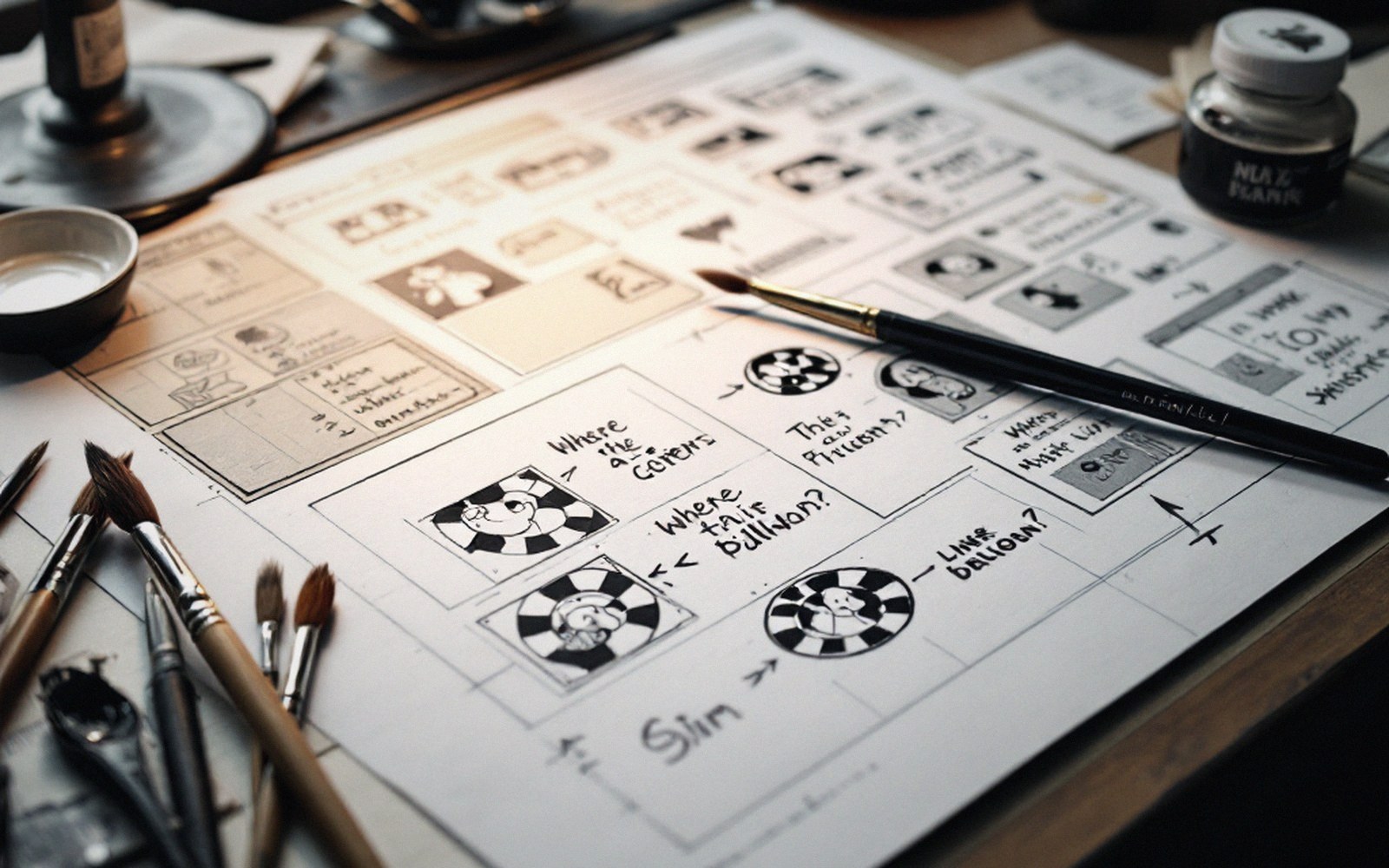
The tail is an instruction, not a decoration
A balloon tail does two things simultaneously, and only one of them gets talked about. The obvious job is attribution: that tapering stroke exits the balloon and points to a mouth, assigning the words to a speaker. The less obvious job is sequencing: the tail anchors a balloon to a position in the panel, and position governs reading order. Both functions depend on the same physical stroke, which means a carelessly placed tail can break the conversation even when every word is spelled correctly.
Reading order in a panel runs left to right, then top to bottom — the same path the eye takes across prose. Balloon placement follows that path, so the first balloon the eye reaches is the first line spoken. The tail then confirms who said it. When attribution and sequence agree, the reader doesn't notice the lettering at all, which is exactly right. When they disagree — when the tail correctly identifies a speaker but the balloon sits in the wrong position — the reader either stumbles, rereads, or silently inverts the dialogue and misses the joke, the revelation, or the emotional beat.

The inversion problem
The failure mode has a specific shape. Two characters face each other. The character on the right speaks first, so their balloon is placed right. The character on the left responds. But the letterer, trying to keep the tail from crossing the panel or overlapping a face, nudges the second balloon up and left until it sits before the first balloon in reading order. Now the response lands before the line it responds to. The exchange reads as though the characters have swapped lines, and a reader who doesn't know the script will simply accept the inverted version. The story doesn't break — it just quietly becomes a slightly different, slightly worse story.
The tail itself didn't cause this. The placement caused it, and the tail merely pointed to the speaker without correcting the sequence. This is why balloon placement is the structural decision and the tail is the confirmation — and why the balloon placement is composition: the letterer is genuinely the last person to change the picture, every time.
Tails that cross and tails that nest
A tail should exit from the part of the balloon closest to the speaker's mouth, travel in a reasonably direct line, and arrive at a point near the mouth itself — not the forehead, not a shoulder, not the general vicinity of the body. The taper conventionally narrows toward the speaker, though some letterers reverse this on shout balloons or tails that travel a long distance, widening the origin to add visual weight.
When two balloons share a panel and their tails cross, the eye tends to follow each tail to the wrong mouth. The standard solution is to redesign the balloon positions so the tails don't cross at all — not to rely on the reader to trace them correctly. If a cross is unavoidable, one tail can be rendered with a break, like a line passing behind another, to indicate depth. This works, but it adds a visual decision to what should be a transparent piece of infrastructure.
A nested exchange — several balloons stacked vertically for a single speaker — needs only one tail on the lowest balloon, with the upper balloons touching or overlapping it to imply continuity. The tail on every balloon in the stack is redundant and visually busy. One pointer is enough once attribution is established; after that, proximity does the work.
The tail will be pointing at the right mouth. The question is always whether it’s pointing from the right place.
The tail as last check
Before a lettered page is handed off, reading the dialogue aloud in strict panel order — left to right, top to bottom, balloon by balloon — is the only reliable way to catch an inversion. The ear hears a backwards conversation before the eye catches it, because the eye has already been primed by reading the script. The tail will be pointing at the right mouth. The question is always whether it's pointing from the right place.