Moiré
Two dot patterns interfering. The reason tone has to match the print screen.
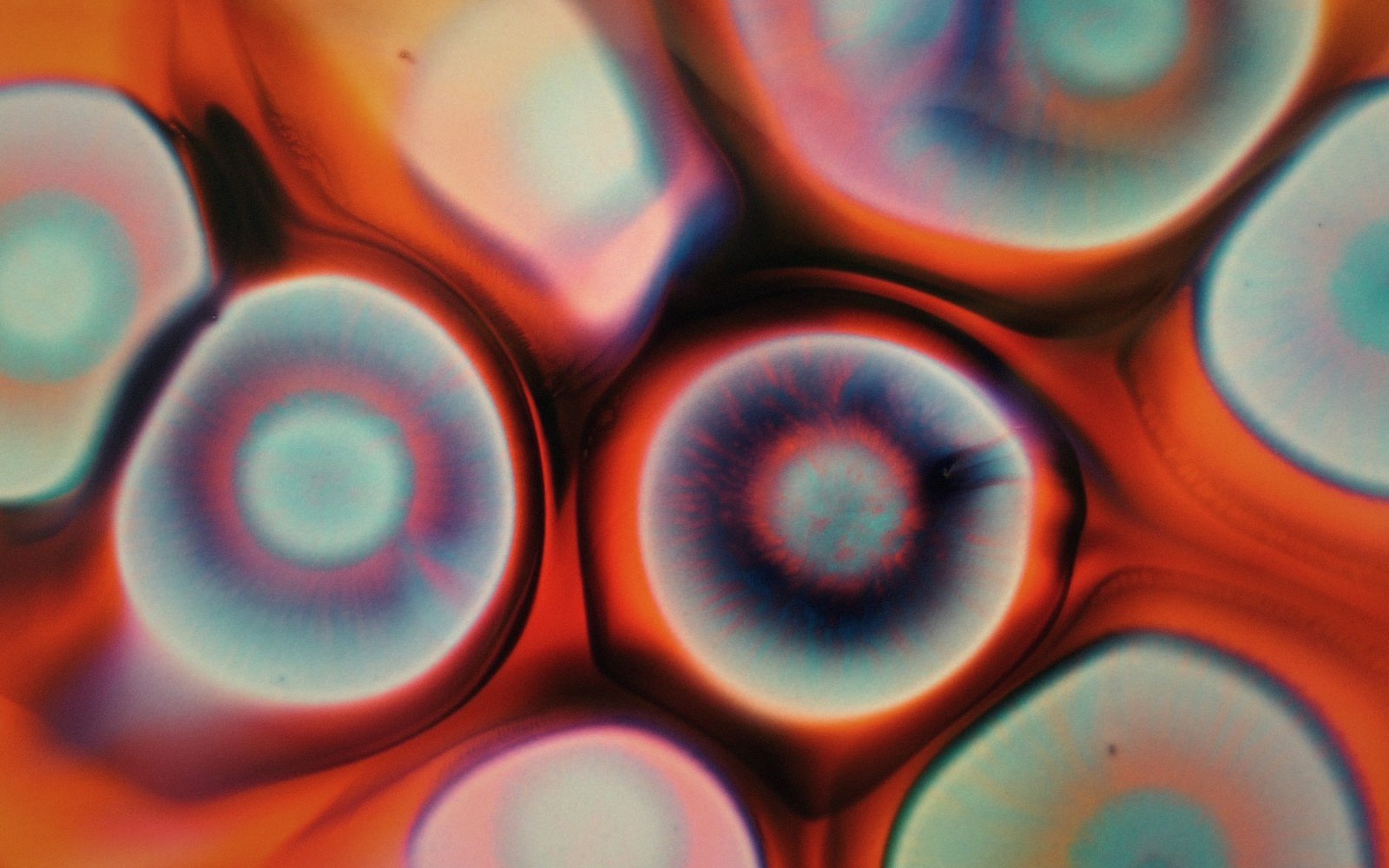
When two grids fight, the page loses
Screentone film is a regular dot pattern printed on adhesive film at a fixed frequency — sixty lines per inch, say, or sixty-five. The printing press that reproduces the finished page uses its own halftone screen, also a regular dot pattern, at its own frequency and angle. When two regular grids overlap, they do not simply add together. They beat against each other, producing a third, larger pattern of dark and light bands. That is moiré, and it is the reason applying tone carelessly is worse than applying none at all.
The interference happens because the human eye averages periodic patterns. Where the dots of the film and the dots of the press happen to align, the result reads dark. Where they happen to cancel, it reads pale. The alternation rolls across the image in waves that can be coarser than the original tone by a factor of ten or more — impossible to miss, impossible to fix after printing.
The only reliable defence is frequency matching. Tone film is manufactured in specific line-rulings precisely because those values correspond to the screen frequencies used by particular printing processes. A sheet rated 60 lpi works cleanly with a press screen running at 60 lpi at the same angle. Misalign the angle even slightly — the film at 45 degrees, the press screen at 52 degrees — and the beat reappears. Traditional studio practice kept a reference sheet of approved tone grades alongside the print specification, chosen together, not separately.
Digital colouring and toning moved the problem one step sideways without removing it. A rasterised dot pattern in a file carries its own implied frequency. If the export resolution or the downstream RIP (raster image processor) resamples that file, the grid shifts and moiré reappears in the press proof. The safe route is the same one it always was: confirm the output specification before committing to a tone value, and where possible supply artwork as vector or at the exact final resolution, so no resampling occurs.
Photographers encounter the same interference when a camera's sensor grid meets a fabric weave. The principle is identical; the context is different. For the cartoonist it is a reminder that screentone is a printed dot pattern working inside a system that already has a grid of its own. Both grids have to agree.